
Most thermostat returns are not caused by the thermostat. They are caused by a specification that looked right on a data sheet and then met a wall box with no neutral wire, a boiler that speaks a different protocol, or a 50 mm frame where the replacement faceplate was designed for 55 mm.
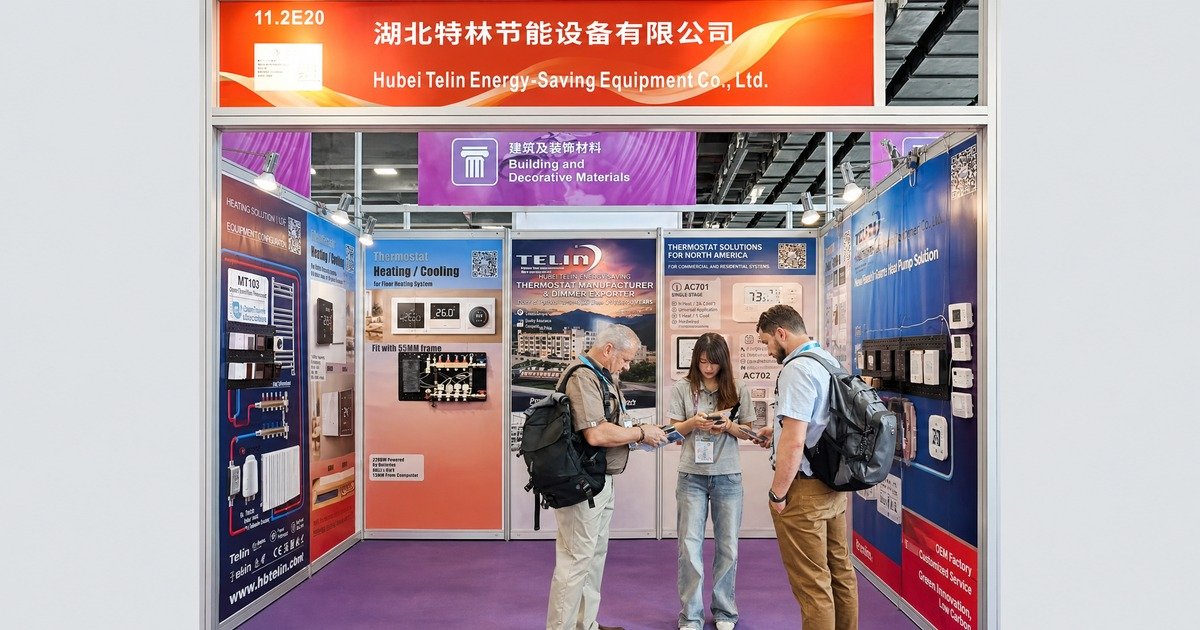
This guide collects the specification questions distributors and installers put to us at our booth this October, in the order they actually decide a purchase.
1. Start with the wiring, not the Wi-Fi
Wi-Fi is the last decision, not the first. Three physical facts decide whether a model can be installed at all:
- Is there a neutral at the wall box? Mains-powered units need live and neutral. Older European installations often carry only a live and a switched live. No neutral means a battery-powered model, not a longer screwdriver.
- What is the frame size? A 55 mm frame lets a failed unit be swapped without re-cutting the opening, re-plastering or repainting. This is the single most common reason a repeat order goes to one supplier instead of another.
- How deep is the box? A backplate with terminals and a manifold wiring block needs more depth than a plain switch plate. Shallow boxes need a spacer or a different model.
Practical check: ask the installer to photograph the existing wall box with the old thermostat removed — one photo showing the wires and the frame opening answers all three questions before you place the order.
2. Match the control protocol to the heat source
An on/off thermostat is a relay: it closes a contact and the heat source runs at its own fixed output. A modulating thermostat such as an OpenTherm model sends a proportional demand over a two-wire low-voltage link, so a compatible boiler or heat pump can lower its flow temperature and follow the actual load instead of cycling at full output.
The benefit is smaller temperature swings and fewer start-stop cycles — which matters most on low-temperature systems. The limit sits on the other side of the wire: if the boiler or heat pump does not speak OpenTherm, the thermostat falls back to relay control and the benefit disappears.
Single stage or two stage?
1H/1C covers one heating and one cooling output, which is the typical floor heating zone. 2H/2C adds a second stage, and buyers asked for it in three situations:
- a heat pump with an electric backup heater, where stage two runs only on cold snaps;
- a large open space that needs staged output to reach temperature without overshooting;
- a system with two emitters, for example floor heating as base load and a fan coil for fast recovery.
| Control type | Best for | Watch out for |
|---|---|---|
| Relay on/off | Simple zones, any heat source | Wider room temperature swing, more cycling |
| OpenTherm modulating | Condensing boilers, heat pumps | Heat source must support OpenTherm |
| 1H/1C programmable | Standard floor heating zones | No backup-stage control |
| 2H/2C programmable | Heat pump + backup, staged output | Higher unit cost than a single stage |
3. Choose the wireless layer by market, not by preference
The wireless question is really a question about who supports the installation afterwards.
| Option | Fits | Support cost |
|---|---|---|
| Wi-Fi 2.4GHz | Single-room retrofit, app control without extra hardware | Depends on the customer’s router; pairing becomes your support call |
| Zigbee | Multi-device projects where a hub already exists | Needs a gateway; better mesh behaviour at scale |
| 868MHz RF | European projects with room-level wireless control | Needs a receiver or hub to bridge to the system |
For multi-zone floor heating, a central wiring box handling up to eight loops turns a thermostat order into a system order: it drives the manifold actuators over 868 MHz and removes one controller per room.
4. Read what is printed on the housing
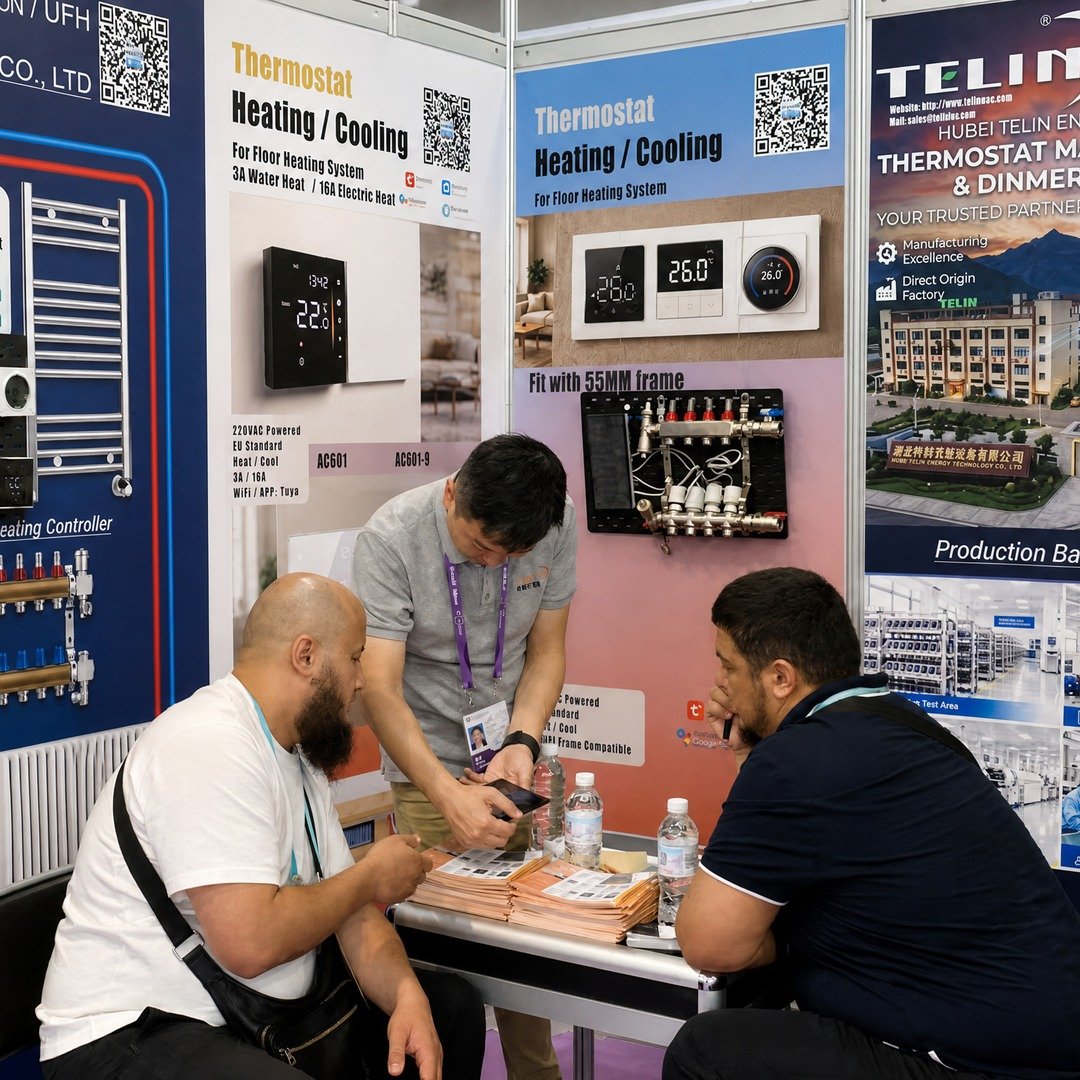
Certification closes more deals than price. The set on our units is CE (EU), UKCA (UK), EAC (Eurasian Economic Union) and RoHS (hazardous substances). They are marked on the product, not only in the catalogue, because a distributor’s compliance file has to point at something physical.
Ask for the marks in a photograph of the actual unit you will receive, and state any additional market scheme at the enquiry stage rather than after the purchase order.
5. Build a stock mix that covers most orders
A distributor does not need twenty SKUs. Four behaviours cover the majority of floor heating and heat pump projects, plus one accessory that sells with every multi-zone job.
| Model | Role in the range | Typical buyer |
|---|---|---|
| AC701 | Single stage 1H/1C programmable, 7-day schedule, battery powered | Standard floor heating zones, retrofit |
| AC702 | Two stage 2H/2C programmable, fan and system switches | Heat pump with backup, larger spaces |
| AC603FH | Integrated thermostat for FCU plus floor heating, 220VAC, 3A water / 16A electric heat | One wall position, two emitters |
| MT103 | OpenTherm thermostat for modulating control | Condensing boiler and heat pump projects |
| TRV TL20 | Radiator valve, Zigbee or Wi-Fi, 3×AA alkaline battery | Mixed radiator and floor heating systems |
Range logic: one frame footprint, several behaviours. Stocking a single faceplate design and two control levels keeps shelf space and installer training low.
6. Six questions worth asking any supplier
- Which models run on mains power, and which need a neutral wire at the wall box?
- Does the thermostat support OpenTherm, and does it fall back cleanly to relay control?
- What frame standard does the faceplate use, and is a 55 mm version available?
- Which certification marks are on the housing for the markets I sell into?
- Who manufactures the unit — is the supplier the factory or a trading office?
- What is the warranty process, and which spare part ships with a replacement?
Frequently asked
Does an OpenTherm thermostat work with a non-OpenTherm boiler?
It can run in relay mode, but modulation and the efficiency benefit are lost. Match the protocol to the heat source first, then choose the model. Can a two-wire installation take a 220VAC thermostat?
Only if a neutral wire reaches the wall box. If there is no neutral, specify a battery-powered model instead of pulling a new wire. What is the difference between 1H/1C and 2H/2C?
1H/1C is one heating and one cooling output. 2H/2C adds a second stage for backup heat, staged output in large spaces, or a second emitter type. Which wireless option should a European distributor stock?
Zigbee where hubs are already common in the customer’s system, 868 MHz RF where room-level wireless control is specified, Wi-Fi for single-room retrofit without extra hardware.
Tell us your market and voltage standard
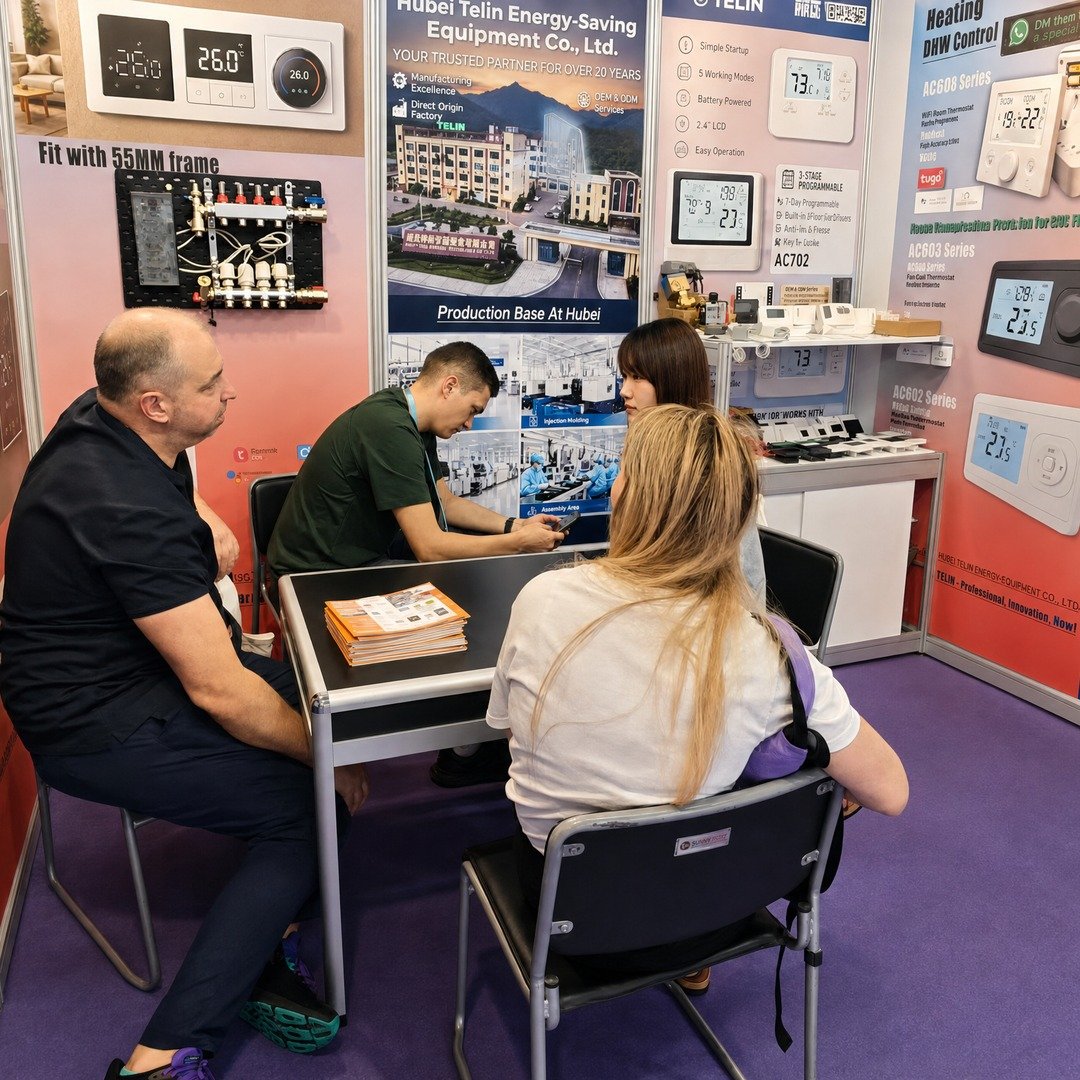
We will reply with the model list that fits your shelf: programmable floor heating, OpenTherm for heat pumps, and integrated FCU plus floor heating units. Made at our own production base in Hubei.
